







Free Delivery on orders above ₹599. Shop Now
Buy 1 Get 1 Free on any product you buy!! Shop Sale

How Indian Festivals Can Become More Sustainable Without Losing Traditions

Diwali means diyas, sweets, family, and light. Holi means colour, water, and joy. Ganesh Chaturthi means devotion, community, and celebration. These aren’t just events — they’re living traditions woven into the identity of millions of Indian households.

But the environmental cost of how we celebrate today has grown significantly. Tonnes of plastic waste generated in a single festival season. Air quality plummeting after Diwali night. Plaster of Paris idols leaching toxins into rivers. Synthetic colours causing skin and water damage during Holi.

The solution isn’t to stop celebrating. It’s to celebrate differently — in ways that are closer to how our grandparents actually did it, before plastic, synthetic dyes, and mass-produced disposables entered the picture.

This blog is a practical guide to making Indian festivals more sustainable without diluting what makes them meaningful. Because the tradition was never the plastic. It was always the people, the rituals, and the intention behind them.

Why Indian Festivals Have a Growing Environmental Problem

The scale of festival-related waste in India is significant and increasing every year.

    • During Diwali, cities across India record dangerous spikes in air pollution from firecrackers, with PM2.5 levels in Delhi and other metros reaching ten to twenty times the safe limit
    • An estimated 50,000 tonnes of plastic waste is generated during the festival season — from packaging, decorations, single-use tableware, and gift wrapping
    • During Ganesh Chaturthi, thousands of Plaster of Paris idols are immersed in water bodies every year, releasing heavy metals and chemicals that damage aquatic ecosystems
    • Holi synthetic colours contain industrial dyes, heavy metals, and chemicals linked to skin irritation, eye damage, and water contamination

None of this is inherent to the festivals themselves. It’s the result of decades of industrialization that replaced natural, biodegradable materials with cheaper synthetic and plastic alternatives — and sold it as convenience and modernity.

Going back to the roots of how these festivals were celebrated is, in many ways, the most sustainable choice available.

Sustainable Diwali: Light, Sweets, and Less Waste

Diwali is perhaps India’s most visually stunning festival — and one of the most wasteful in its current form. But sustainable Diwali ideas don’t require giving up the glow. They require going back to what Diwali was always about: light, warmth, and togetherness.

Lighting:

    • Use clay diyas instead of electric decorative lights or plastic LED strings that break after a season. Diyas are biodegradable, locally made, and support traditional artisans — they are the original Diwali decoration
    • If you use electric lights, choose LED string lights that are energy-efficient and durable enough to last many seasons
    • Avoid plastic lanterns and single-season decorations that end up in landfill after one use

Firecrackers: This is the most contentious part of a sustainable Diwali conversation — but the health and environmental data is clear. Air quality on Diwali night in most Indian cities reaches hazardous levels, affecting children, the elderly, and anyone with respiratory conditions most severely.

    • Choosing to reduce or skip firecrackers is one of the single highest-impact decisions a household can make during the festival season
    • Many communities are shifting toward light and sound shows, community diya lighting, and music as alternatives that preserve the festive spirit without the pollution

Sweets and gifting:

    • Buy mithai from local halwais in reusable steel or glass containers rather than elaborate plastic-packaged gift boxes
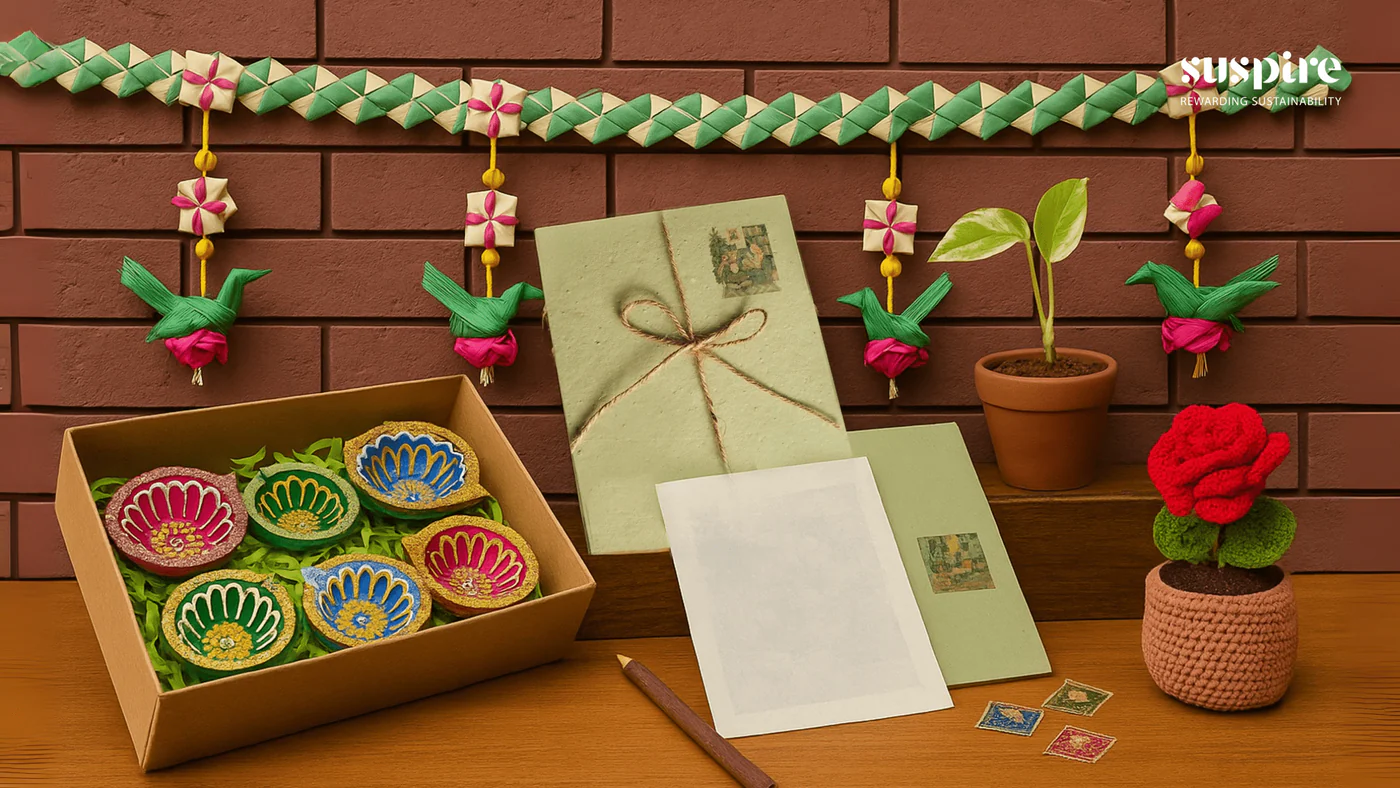
    • Give eco friendly gifting India options: potted plants, handmade products from local artisans, organic food hampers in cloth or jute packaging, or experiences over objects
    • Avoid the mass-produced plastic gift sets that dominate the market — they generate packaging waste immediately and rarely carry personal meaning

Decoration:

    • Use rangoli made from rice flour, flower petals, or natural powders instead of synthetic coloured powders
    • Repurpose marigold garlands and flower decorations for composting after the festival

Green Holi: Colour Without the Chemical Cost

Holi is a celebration of colour, community, and the arrival of spring. It is also one of the most chemically intensive festivals in the Indian calendar — at least in its modern form.

Synthetic Holi colours are manufactured using industrial dyes including lead oxide, copper sulphate, aluminium bromide, and Prussian blue. These cause skin rashes, eye irritation, and respiratory issues on contact — and wash into water bodies, contaminating local water supplies.

Eco friendly festival ideas for Holi:

    • Make or buy natural colours from flowers, vegetables, and plant-based sources:
      • Yellow from turmeric or marigold petals
      • Red from dried hibiscus or pomegranate skin
      • Green from dried spinach or henna powder
      • Pink from beetroot or rose petals
      • Purple from lavender or blueberry
    • Natural colours are gentler on skin, wash off easily, and biodegrade without harming water systems
    • Reduce water use — traditional Holi used flowers and dry colour; the water-intensive version is a relatively recent shift. Water conservation during Holi, especially in water-stressed regions, is a meaningful choice
    • Avoid plastic water balloons — they shred into microplastic fragments that end up in soil and drains. Use fabric water pouches or simply enjoy dry colour play

Ganesh Chaturthi and Navratri: Returning to Natural Materials

Few sustainable shifts carry as much environmental impact as moving away from Plaster of Paris (PoP) idols during Ganesh Chaturthi — and the movement to do so has been gaining momentum across Maharashtra and beyond.

Why PoP idols are harmful:

    • PoP does not dissolve in water — it settles at the bottom of rivers, lakes, and the sea, disrupting aquatic ecosystems
    • Chemical paints used on PoP idols release heavy metals into water bodies during immersion
    • The cumulative impact of thousands of idols immersed in the same water body is severe

Sustainable alternatives:

    • Clay idols (shadu mati) — the traditional choice. They dissolve naturally in water without causing harm. Many artisans have returned to this material in response to growing demand
    • Paper mâché idols — lightweight, biodegradable, and increasingly available
    • Home immersion — immersing the idol in a bucket of water at home and using the clay-rich water for plants is a meaningful and responsible practice
    • For Navratri, choose natural fabric decorations, locally made clay diyas, and avoid synthetic garlands and plastic decoration sets

Eco Friendly Gifting India: Rethinking What We Give

The gifting culture around Indian festivals has become one of the largest sources of single-use plastic waste in the country. Elaborate cardboard and plastic boxes, synthetic ribbons, thermocol packing — most of it is in a bin within minutes of being opened.

Sustainable gifting isn’t about giving less. It’s about giving with more intention.

What eco friendly gifting in India actually looks like:

    • Practical, lasting gifts — stainless steel bottles, cloth bags, beeswax wraps, compost kits, or plant kits that will be used long after the festival
    • Local and artisan-made — support potters, weavers, and traditional craftspeople whose work is inherently sustainable and culturally meaningful
    • Edible gifts in reusable packaging — homemade sweets, organic spice sets, or specialty teas presented in steel dabbas, glass jars, or cloth pouches the recipient can keep
    • Experiences — a shared meal, a workshop, a donation in someone’s name — gifts that create no waste at all
    • Minimal, honest packaging — newspaper, recycled paper, fabric wrapping in the Japanese furoshiki style. The wrapping is part of the gift, not a layer of plastic to throw away immediately

When you give sustainably, the gift carries a message beyond its contents. It says you thought about it — about the person, and about what the giving itself costs.

The Takeaway

Indian festivals were never designed to be wasteful. Clay, flowers, natural colours, handmade sweets, cotton and silk textiles, locally crafted idols — the original materials of Indian celebration were biodegradable, locally sourced, and carried deep cultural meaning.

The plastic, the synthetic dyes, the PoP, the disposable tableware — these are recent additions. And they can be undone without touching what actually makes these festivals sacred.

Sustainable festival living in India isn’t a compromise. It’s a reclamation. It’s choosing the diya over the plastic light. The natural colour over the chemical powder. The clay idol over the PoP. The meaningful gift over the packaged one.

The tradition was always the intention, the ritual, and the people around you. Those don’t have to change at all.

At Circulr, we make it easy to celebrate sustainably — with products and gifting options designed to honor Indian traditions and protect the environment they’re rooted in. Explore our festival-ready range and make this season one you feel genuinely good about.

A Little Extra For
Your First Order

Get an additional 5% off when you shop with Circulr for the first time.
Use the code below at checkout.
Shopping Cart
Your cart is currently empty!.

You may check out all the available products and buy some in the shop.

Continue Shopping
Add Order Note
Estimate Shipping