



Your cart is currently empty!.
You may check out all the available products and buy some in the shop.
Continue Shopping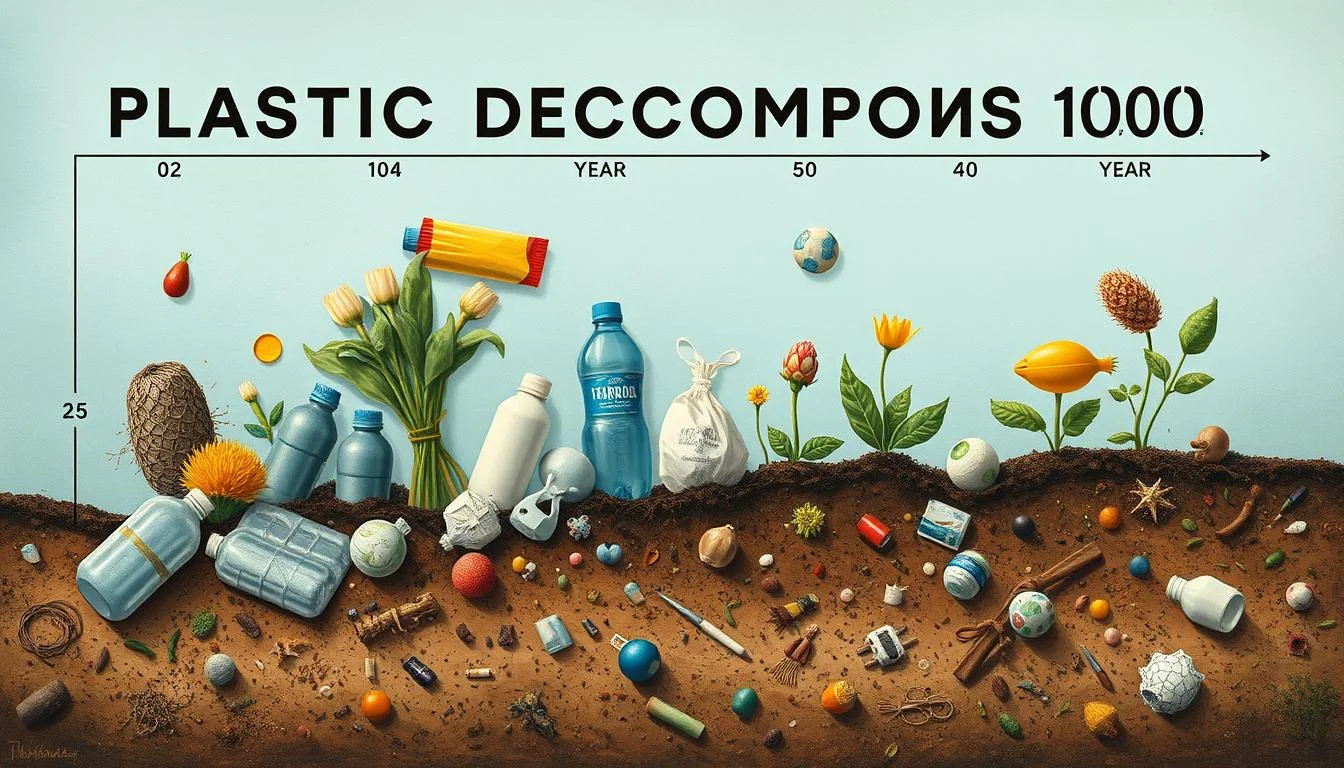 The Science of Decomposition: How Long Everyday Products Stay on Earth
Every time you throw something away, it doesn’t disappear. It goes somewhere — a landfill, a drain, a roadside dump, a water body — and it stays there. The question is: for how long?
Most people have a vague sense that plastic is bad and natural materials are better. But the actual numbers — the decomposition timelines of everyday products — are rarely discussed in a way that makes them feel real. When you understand that a single plastic bottle will outlast everyone alive today by several centuries, the abstraction becomes something harder to ignore.
This blog breaks down the science of decomposition — what it actually means, why some materials last and others don’t, and how the everyday products in your home rank on the timeline from days to millennia. Understanding this changes how you see every purchase and every piece of waste you generate.
Decomposition is the process by which organic matter is broken down by microorganisms — bacteria, fungi, and other living organisms — into simpler compounds that return to the soil, air, and water. It’s the biological recycling system that has kept the Earth’s nutrient cycles running for billions of years.
The key word is organic. Natural materials — wood, cotton, food, paper, wool, leather — are built from carbon-based compounds that microorganisms have evolved to break down. Given the right conditions of moisture, oxygen, temperature, and microbial activity, these materials return to the earth within months to decades.
Synthetic materials — particularly plastics — are a different story entirely. Most plastics are made from petroleum-derived polymers that did not exist in nature until the twentieth century. Microorganisms have had virtually no evolutionary time to develop the capacity to break them down. As a result, plastics don’t biodegrade in any meaningful sense — they photodegrade, breaking into smaller and smaller fragments under UV light until they become microplastics that persist in soil and water indefinitely.
The distinction matters enormously when evaluating the waste impact on the environment of the products we use every day.
Here is how long common everyday products take to decompose under average environmental conditions — not in ideal laboratory settings, and not in anaerobic landfill conditions where even biodegradable materials break down far more slowly.
Days to Weeks:
These materials decompose relatively quickly because they are made of organic compounds — cellulose, protein, natural fibres — that soil microorganisms are well-equipped to process. Under composting conditions, many decompose even faster.
Years to Decades:
These materials take significantly longer because they involve more complex compounds or metals that require specific conditions to break down. Aluminium, notably, never truly biodegrades — it oxidizes and fragments, but the metal atoms remain in the environment indefinitely.
Centuries to Never:
The numbers for plastic deserve particular attention. A plastic bag used for fifteen minutes takes between 10 and 1,000 years to fragment — and even then, it doesn’t disappear. It becomes microplastics: particles smaller than 5mm that contaminate soil, water, and the bodies of living organisms. There is no true end point for plastic decomposition. It simply gets smaller.
The decomposition timelines above assume average environmental conditions — exposure to air, sunlight, moisture, and microbial activity. Landfills, where the vast majority of India’s waste ends up, provide almost none of these conditions.
How landfills slow decomposition:
The result is that even biodegradable materials — food scraps, paper, natural fibres — decompose far more slowly in landfill than in open environments or composting systems. Researchers have found 30-year-old newspapers still legible when excavated from landfills. Recognizable food waste has been found in landfills decades after disposal.
When organic waste does break down anaerobically in landfills, it produces methane — a greenhouse gas 25 to 80 times more potent than carbon dioxide over different time horizons. India’s overflowing, unlined landfills are significant sources of methane emissions, making food waste in landfill a climate issue as much as a waste management issue.
This is why composting food waste at home is one of the highest-impact actions an Indian household can take: it diverts organic material from methane-generating landfill conditions into aerobic decomposition that produces useful compost instead of greenhouse gas.
The terms “biodegradable” and “compostable” are among the most misused in the sustainability space — and understanding the difference between them and conventional plastic is essential for making informed choices.
Biodegradable: A material is biodegradable if it can be broken down by microorganisms. But this term has no regulated timeline attached to it. Technically, almost everything is biodegradable given enough time — including some plastics, over hundreds of years. A product labelled “biodegradable” without specifying a timeframe or certification is making a claim that may be technically true but practically meaningless.
Compostable: A compostable material breaks down into non-toxic components within a specified timeframe under composting conditions. There are two standards:
Home compostable is the higher and more practically useful standard for Indian households. Look for third-party certification (EN 13432, ASTM D6400, or AS 5810 for home compostable) before trusting a compostability claim.
Oxo-degradable plastic: This is a form of greenwashing worth knowing about. Oxo-degradable plastics contain additives that cause them to fragment into smaller pieces faster than conventional plastic — but they do not biodegrade. They simply become microplastics more quickly. Several countries have banned oxo-degradable plastics. They should not be confused with genuinely compostable materials.
Conventional plastic: Conventional plastic — the kind in most packaging, bottles, bags, and disposable items — does not biodegrade. It photodegrades into microplastics that accumulate in ecosystems indefinitely. When a product is made from conventional plastic, its landfill waste impact on the environment is effectively permanent.
Understanding decomposition timelines transforms how you evaluate everyday purchasing decisions. Here’s how the science translates into practical choices:
For food storage and kitchen:
For personal care:
For clothing:
The guiding principle: Choose materials that, at the end of their useful life, can return to the earth without leaving permanent residue. Natural, renewable, uncoated, uncomposited materials almost always meet this standard. Synthetic, petroleum-derived, or mixed-material products almost never do.
The things you throw away don’t disappear. They enter a timeline that stretches from weeks to centuries — and in the case of plastic, effectively forever.
A banana peel is gone in weeks. A cotton shirt biodegrades within years. A plastic bottle purchased today will still exist, in some form, in the year 2475. A glass bottle discarded today will outlast human civilization as we know it.
These numbers are not designed to produce guilt. They’re designed to produce clarity. When the lifespan of a material is understood, the choice between a natural alternative and a plastic one stops being abstract. It becomes concrete — a decision about what you’re willing to leave behind.
Choose materials that can return to the earth. Compost what can be composted. Recycle what can be recycled. And above all, reduce the volume of long-lived synthetic materials you bring into your life in the first place.
The earth has been cycling materials for billions of years. The best products are the ones that participate in that cycle — not the ones that interrupt it permanently.
At Circulr, every product we offer is chosen with its full lifecycle in mind — including what happens when you’re done with it. Explore our range of genuinely biodegradable, compostable, and long-lasting sustainable alternatives to the products filling your bin today. Choose what returns. Choose Circulr.